
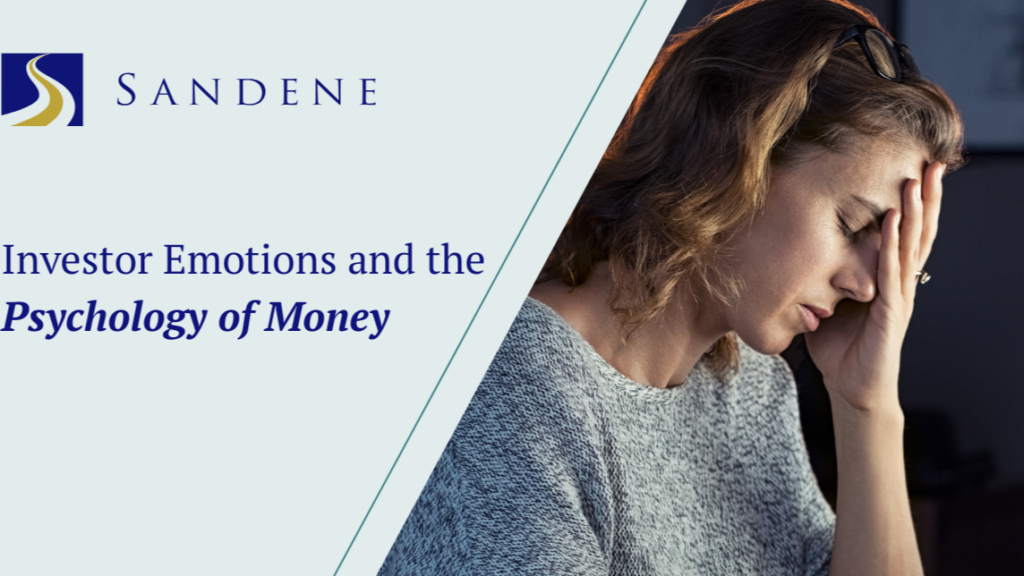
It’s not a newsflash to say, “people get emotional about money.”
However, modern macroeconomics is based on rational choice theory.
That is, individuals make money and investment decisions by logically weighing costs and benefits to maximize their personal wealth.
Ah, if it were only that easy!
While rational choice theory generates clean mathematics, its output is fraught with real-world limitations.
The Limitations of Rational Choice Theory
It’s not practical to expect people to have perfect information and evaluate every alternative.
More importantly, human decision-making is heavily influenced by emotions, biases, and other psychological factors.
The reality of imperfect human decision-making led to the development of what’s now known as behavioral economics, a discipline that observes how people actually make decisions.
Behavioral Economics
Daniel Kahneman and Alex Tversky pioneered this school of thought with their landmark 1979 publication, “Prospect Theory: An Analysis of Decision under Risk.”
Their research led to the discovery that people really do feel the pain of losses greater than they feel the joy of gains. This phenomenon, a bias known as loss aversion, was a major breakthrough in the understanding of people and money.
Here’s a simple example: Imagine a fair, two-sided tossed coin.
Most people would decline the gamble if the prospective outcomes were, “heads you lose $100, tails you win $100.”
Kahneman and Tversky found that people will decline the gamble until the payoff for winning reaches $250.
Therefore, loss aversion can be quantified as the pain of losses being 2.5 times greater than the joy of gains.
Investors’ loss aversion is significantly challenged during prolonged bear markets: stock market declines exceeding 20%.
Two concepts are particularly helpful during these difficult periods for investors and clients: broad framing and mental accounting.
Broad Framing and Mental Accounting
For investors with a diversified portfolio, it’s very disheartening to see huge losses.
However, sometimes, “Everything goes down, and there’s no place to hide.”
Under those circumstances, broad framing (the process of stepping back and looking at the big picture) is a useful tool.
For example, when in the midst of a generational bear market for equities, such as the 57% decline that occurred during the 2007-2009 “great financial crisis,” it helps to look at a chart showing a 100-year history of U.S. stock prices.
For investors with a long enough time horizon, stock indexes have always, 100% of the time, fully recovered their prior price levels.
The odds are also in favor of investors with intermediate time frames.
In the last 100 years, the S&P 500 has only been negative for a ten-year period four times, and negative for a five-year period twelve times.
Mental accounting is the equivalent of partitioning one’s funds into “buckets of money” earmarked for particular purposes, such as emergency funds, buying a home, college expenses, or retirement.
Despondency in the Real World
In early 2009, during the deepest moment of a severe equity bear market, I met with a client couple who was seven years away from retirement.
Their investment portfolio was down 20%, from $2,000,000 to $1,600,000. After 18 months of watching their investments cascade down $400,000, they were afraid it was all going to disappear.
Daily market and business news reporting, with doomsday headlines and stories questioning the viability of the nation’s largest banks, wasn’t helping matters.
This couple was finished with investing, ready to sell everything and stash their cash in a mattress.
I asked them to take a deep breath and listen to a few facts.
While acknowledging their pain, I reminded them of their time horizon and that the odds were in their favor (broad framing).
I was fairly certain, based upon market history, this bear market was closer to its end than its beginning, and I figured the stock market would be higher in two years.
I also knew this couple wasn’t currently withdrawing funds for their investments.
Therefore, I asked them how much of their investments could they possibly need (for emergencies) over the next two years.
They responded, “$200,000.”
I immediately turned to my computer and sold $200,000 of stock mutual funds, creating an “emergency funds” bucket (mental accounting) for these clients.
The stock market turned around soon thereafter, and this couple’s retirement story has a happy ending.
Investing Is a People Business
In situations like this, it’s essential to remember this is a people business and the money is real.
One of my biggest responsibilities is to keep clients from making money mistakes due to their emotions and biases.
That’s why I studied behavioral finance and obtained an Accredited Behavioral Finance Professional® (ABFP®) designation.
There are times when this behavioral finance knowledge is more important than the knowledge I carry as a Certified Financial Planner® professional (CFP®).
I look forward to serving you with this and other knowledge that comes with 29 years of financial advising experience.
Now Is Not the Time to Panic Sell! Let’s Talk About How to Move Forward During These Uncertain Times
Life is unpredictable at the best of times, but with headlines about bubbles and big swings in the markets seeming to happen every other week, it can feel doubly so right now.
While the ideas of broad framing and mental accounting sound simple, it’s not so easy when fear and panic start to grab you.
I get it. For decades, I’ve helped my clients figure out strategies to get through difficult times despite what their emotions were shouting at them.
Let’s chat about what you’re struggling with and how I can potentially help.
Your Future Is Now. Let’s Get To Work!
Schedule an Introductory Call