
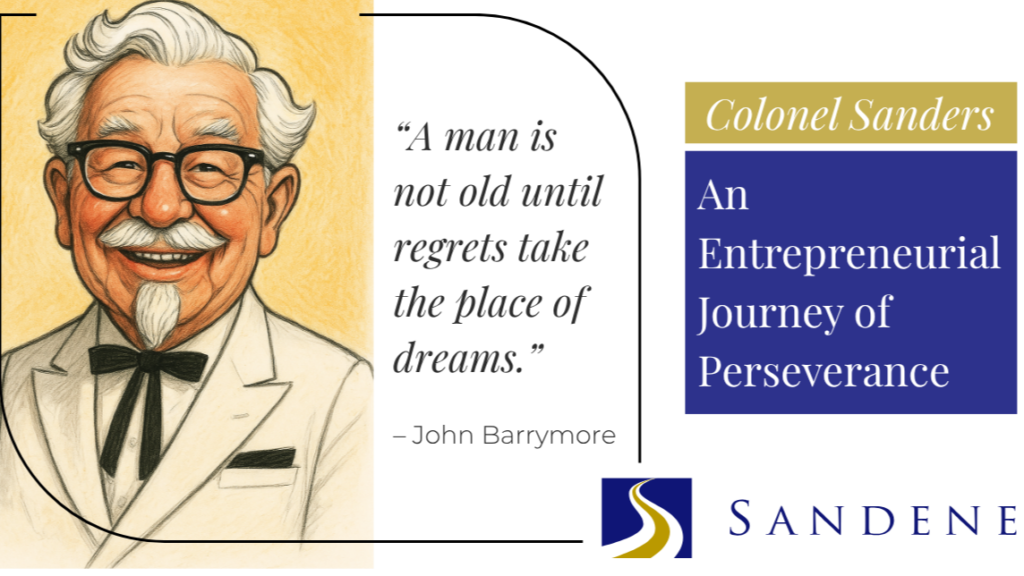
“A man is not old until regrets take the place of dreams.” – John Barrymore
I spent the first fifteen years of my career in corporate finance positions. As my responsibilities increased, my enthusiasm for playing a supporting role in big company diminished proportionally.
Dictating policy and keeping score from an ivory tower—separated by many degrees from the products, services, and customers of the business—was tremendously unfulfilling.
By the time the voice of my entrepreneurial spirit became unbearably loud, I was leading a department with thirty direct reports.
While I had my own project responsibilities, I spent most of my time in meetings with other department heads and dealing with employee issues. On most days I wasn’t able to work on my projects until after everyone else left for the day.
Time for a Change… but What to Choose?
I was mentally knocked-out from the corporate world and had a strong desire to start and run my own business. But what would it be?
I wasn’t an engineer or software programmer, so creating a marketable product or service wasn’t a viable option. However, with an MBA in Finance, I did understand more about money and investing than most people. So, I decided to give a career in financial services a shot.
The magnitude of this decision hit me on my first day as a financial advisor. I was 100% commission, with a cubicle, telephone, and no clients. The good news was I had no employee issues to deal with and was fully responsible for my outcomes. I happily said, “Let the free market determine my economic value!”
Being a Solopreneur
For the first twenty-six years of my career as a financial advisor, I was essentially a solopreneur, with administrative assistance but not running an independent, easily transferable business.
After experiencing a series of business setbacks, I joined a peer group of business professionals and began reading books on growth and building business value. Soon after, at the age of 62, I decided to double down on growing my business and creating a company that could run without my day-to-day involvement.
About that time, I rediscovered Colonel Harland Sanders and became inspired by his amazing story of entrepreneurship and perseverance.
An Incredible Journey that Seemed Impossible
Colonel Sanders’ resume reveals that he was unemployable. He was intelligent and free-spirited, on a journey to find his life’s true calling. This led to a very transient early career.
He never stayed in one place or position very long. His jobs before age forty included stints as a ferry operator, train conductor, midwife, firefighter, lawyer, life insurance salesman, and gas station owner.
During this time, he suffered through many setbacks, disappointments and failures, but he continued marching forward, gaining valuable wisdom from his experiences.
Sanders finally landed in what would be his ultimate passion—food service—in his early forties. He set up a small restaurant next to his gas station, “Sanders Court and Café.”
His popular fried chicken made him a local legend and earned him the honorary title of “Colonel” from the Kentucky governor.
The Beginning of KFC
For twenty years, Sanders operated this North Corbin, Kentucky restaurant while perfecting his fried chicken recipe. Then, with his “eleven herbs and spices” recipe and unique, pressure-cooking methodology fully developed, at age 62, he sold his first fried chicken recipe license to a restaurant operator in Utah.
The name Kentucky Fried Chicken was coined by the Utah operator to evoke imagery of southern hospitality and to differentiate his restaurant from local competitors. For the next couple of years, Sanders had limited success selling licenses to other restaurant operators.
He suffered a major setback in 1956 (age 65) when the construction of Interstate 75 rerouted traffic away from the North Corbin location, resulting in the restaurant’s closure.
The Colonel was left with a small licensing income stream, a $105 monthly Social Security check, and depleted savings. Sensing a now-or-never situation, he decided to go all-in on selling full Kentucky Fried Chicken franchises.
Building Back to Greatness
Sanders criss-crossed the United States looking for suitable restaurants and negotiating franchise rights with workers who liked the fried chicken he cooked for them.
These time-consuming and exhausting journeys, on a limited budget, often left him sleeping in the back seat of his car in motel parking lots.
Colonel Sanders’ relentless selling effort paid off. As the number of franchisees grew, industry buzz about Kentucky Fried Chicken increased. Eventually, potential franchisees began visiting Sanders at his new restaurant and company headquarters in Shelbyville, Kentucky.
Over the next several years, the company’s expansion accelerated across the U.S. and into Canada. By 1964, Kentucky Fried Chicken had over 600 locations around the world, trademarked its “Finger Lickin’ Good” tagline, and turned Colonel Sanders into the company’s iconic spokesman.
It’s Never too Late to Go All in
Leading and scaling a global business became an overwhelming responsibility for an aging Sanders. With the company running on all cylinders in 1964, Colonel Sanders, at age 73, negotiated a successful exit from Kentucky Fried Chicken Corporation.
His sale proceeds of $20 million (today’s dollars) were an ample reward for his lifetime of trials, tribulations, hard work, and perseverance.
Sanders was living proof that you’re never too old—and that it’s never too late—to go all in and chase your dream.
Colonel Harland Sanders continued to make personal appearances as Kentucky Fried Chicken’s spokesman after selling the company, all the way to his death in 1980 at age 90.
Follow us for more great content! → https://bit.ly/4ocPl3n